Copyright © 2009 Infosoft Education. All rights reserved.
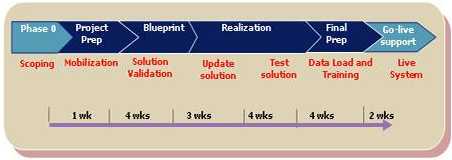
The full implementation Cycle Of ERP
- Scoping - What is to be implemented i.e. which sub modules are to be implemented some clients may not require credit management for example. Look at the project scope document carefully it will tell you what ERP/SAP sub-modules in ERP/SAP you should be prepared for. Usually the sales people along with project manager do it.
- Blueprinting - Here you understand the existing business processes of the client consisting of identifying the client current process, requirement and how ERP/SAP provides solution. Consists of detailed documentation you also do a Level -2 training for your client so he is made aware of all the required transactions in ERP/SAP. Also the as-is and to-be and gap analysis is explained. This is the document that you will be using to do your configuration in the realization phase.
- Realization phase : Here you do the configuration in the development server (there are three clients -development, quality, production). You also decide on the master data format, so that client can go collect the master data. You also give ABAP specifications for forms, reports etc, system modifications etc. Unit testing: Your client and a few key users sit down and test your configuration in your module only. It is good to test the BDCs that you need for uploading data at this stage so you have more realistic data and your BDCs are tested.
- Integration testing: Once all modules unit testing is over then the configuration is transported to the Quality server, where testing for all the modules is done by client and end user, this is to check if any problems are there in integration between various modules. Once all is okay from the QA server config is transported to the production server.
- Go live preparation
- Data uploading: The collected master data is checked and the uploaded into production server. Now you are ready for go live i.e. users can now use the production server.
Get books of SAP all modules & Laptops.